A powerful earthquake shook Peru killing hundreds and injured at least 1,000. Many people were killed in the rubble of their homes and some were in a cathedral when it collapsed.
You can help victims right now by supporting the charities below:
American Jewish Joint Distribution Committee (JDC); Donate Now
Mobilizing efforts to help those in need
American Red Cross; Donate Now
Supporting the International Federation of Red Cross and Red Crescent Societies in its response to the earthquake
Call 1-800-257-7575 to speak to someone at the Red Cross in Spanish
CARE; Donate Now
Assessing the humanitarian needs and will respond accordingly
CHF International; Donate Now
Mobilizing staff to assess needs and damage, and designing both immediate and long-term recovery programs
Direct Relief International; Donate Now
Offering assistance to the Peruvian American Medical Society (PAMS) and healthcare partners
MADRE; Donate Now
Responding with urgently needed items like blankets, clothing, food and medecine
Oxfam; Donate Now
Assessing damage and humanitarian needs in the region south of Lima
Partners of the Americas; Donate Now
Focusing on short-term relief for disaster-stricken areas
Save the Children; Donate Now
Conducting a rapid assessment of the needs of children and their families, and to provide lifesaving relief
World Vision; Donate Now
Helping to deliver relief survivors
UNICEF; Donate Now
Transporting emergency supplies and making sure the affected population has safe water
Volunteers for Inter-American Development Assistance (VIDA); Donate Now
Delivering donated medical and disaster relief supplies
You can also support recovery projects in Peru at GlobalGiving
Thursday, August 16, 2007


Thursday, July 05, 2007
Help Flood Victims
Areas across northern and central Texas have been hit with floods that have submerged hundreds of homes and businesses. Heavy rains have also caused flooding in Oklahoma and Kansas. Victims need your help to provide things like meals, snacks, and shelter while relief groups assess the ongoing assistance that these communities will require.
Donate Now
American Red Cross Disaster Relief Fund
Donate Now
Catholic Charities of Central Texas
Donate Now
American Red Cross Disaster Relief Fund
Donate Now
Catholic Charities of Central Texas
Thursday, May 17, 2007
Wedding Favors for Charity

Looking for wedding favors that are unique, meaningful, and will always remind guests of your special day? Make a donation to your favorite charity in honor of your guests—the most personal gift you can give:
* Honor a loved one with a donation to their favorite charity.
* Celebrate your community with a donation to a local charity.
* Remember a family member with a memorial donation.
* One for each of you? Choose two charities.
How Favors for Charity Works:
* Decide how much to donate; give a set amount or a few dollars per guest.
* Order place cards to let your guests know about your gift. (optional)
* Make a donation and purchase place cards; we will send you a receipt
* We make the donation to the charity of your choice.
Get started today!
Tuesday, May 08, 2007
Midwest Tornadoes
A deadly tornado struck southwestern Kansas destroying most of the town of Greensburg. You can help those affected by the tornado by helping to provide shelter, food and emergency supplies.
>Make a Difference. Volunteer.
>American Red Cross: Donate Now!
>Safe and Well List: report your status or search for a loved one
>Make a Difference. Volunteer.
>American Red Cross: Donate Now!
>Safe and Well List: report your status or search for a loved one
Thursday, April 19, 2007
Help the VA Tech community
You can remember and honor the victims of the tragic events by making a donation to the Hokie Spirit Memorial Fund. The fund was established by the university to aid in the healing process and generate financial support.
Money raised will be used to cover expenses such as:
Assistance to victims and their families
Grief counseling
Memorials
Communication expenses
Comfort expenses
You can also spread the word about the memorial fund by adding the charity badge at right to your website, blog or social networking page; all you have to do is click on "copy" and you can display the badge anywhere online.
Some additional sizes:
Money raised will be used to cover expenses such as:
Assistance to victims and their families
Grief counseling
Memorials
Communication expenses
Comfort expenses
You can also spread the word about the memorial fund by adding the charity badge at right to your website, blog or social networking page; all you have to do is click on "copy" and you can display the badge anywhere online.
Some additional sizes:
Got fundraising ideas? ChipIn!
Create fundraisers for free
Eco Chic Flowers for Mom
Since Eco Chic is all the rage these days, why not give an organic bouquet to Mom this year for Mother's Day? You can send fabulous flowers that benefit charity through Flowers for Good. She’ll love it and it supports mother earth!
>Order any flowers or product from www.flowersforgood.com; all flowers are grown using the best certified sustainable practices
>Choose from among 10 charities; learn more
>We'll include a message about your donation when we send your flowers!
>Order any flowers or product from www.flowersforgood.com; all flowers are grown using the best certified sustainable practices
>Choose from among 10 charities; learn more
>We'll include a message about your donation when we send your flowers!
Monday, March 05, 2007
Alabama and Georgia Tornadoes
Tornadoes have hit areas all over the South this past week, killing and injuring many people in its path as well as destroying local businesses and houses. You can help victims affected by the disaster.
>American Red Cross: Donate Now!
>Alabama Disaster Relief Drive
>Give blood
>American Red Cross: Donate Now!
>Alabama Disaster Relief Drive
>Give blood
Sunday, February 04, 2007
Flowers for Good
Not sure how to thrill your Valentine this year? We have a GOOD way! Give Flowers for Good; your Valentine will love them and so will some of your favorite charities!
>Order any flowers or product from www.flowersforgood.com; all flowers are grown using the best certified sustainable practices
>Choose from among 10 charities; learn more
>We'll include a message about your donation when we send your flowers!
If you are feeling lucky, you can register to win the World's Tallest Roses!
>Order any flowers or product from www.flowersforgood.com; all flowers are grown using the best certified sustainable practices
>Choose from among 10 charities; learn more
>We'll include a message about your donation when we send your flowers!
If you are feeling lucky, you can register to win the World's Tallest Roses!
It's Tax Time!
As tax time draws near, be sure to access your donation history and claim your tax deduction.
You can also find answers to common questions about charity and tax deductions in the Network for Good Tax Guide
You can also find answers to common questions about charity and tax deductions in the Network for Good Tax Guide
Tuesday, December 05, 2006
Award-winning charities
This month, Fast Company and Monitor Group recognize some incredibly innovative charities in the Social Capitalist Awards. They honored leaders who combine savvy business models with solutions to pressing social needs, from Maria Otero, who has trained banks around the world to provide small loans to poor people at Accion International to Rob Waldron of Jumpstart, which trains college students to work in pre-schools in low-income areas.
You can give to any of the winners' charities through Network for Good on the award site.
You can give to any of the winners' charities through Network for Good on the award site.
Thursday, November 30, 2006
World AIDS Day
In honor of World AIDS Day, consider a donation to one of the following charities.
YouthAIDS
Elizabeth Glaser Pediatric AIDS Foundation
AmFAR
Also, check out the YouthAIDS "kick me" campaign for an unusual, attention-getting way to take action!
YouthAIDS
Elizabeth Glaser Pediatric AIDS Foundation
AmFAR
Also, check out the YouthAIDS "kick me" campaign for an unusual, attention-getting way to take action!
Thursday, October 26, 2006
Who is Giving Online?
If your're curious about who is making charitable donations online, the answers are in a study we recently released on $100 million in online giving to 23,000 charities.
Some highlights of the study are:
-Online givers are young (38-39 years old) and generous, giving several times more than offline donors on average.
-Virtually all of them (96%) have given to charity before, but a sizable proportion (38%) is new to online philanthropy.
-Online giving is tracking to the trends of online shopping and banking, and it is the avenue of choice for donors during disasters.
-Most people give online during the week, during business hours – most commonly, between 10am and noon.
-New York is the most generous state for online giving; Mississippi and North Dakota are the least generous.
-Giving online follows the same “long tail” phenomenon seen in online sales of books and music.
-Most online giving goes to disaster agencies.
-People say they give online because it’s easier than writing a check and a fast way to respond to disasters.
If you want to share feedback on why you give online through Network for Good, we would love to hear from you!
Some highlights of the study are:
-Online givers are young (38-39 years old) and generous, giving several times more than offline donors on average.
-Virtually all of them (96%) have given to charity before, but a sizable proportion (38%) is new to online philanthropy.
-Online giving is tracking to the trends of online shopping and banking, and it is the avenue of choice for donors during disasters.
-Most people give online during the week, during business hours – most commonly, between 10am and noon.
-New York is the most generous state for online giving; Mississippi and North Dakota are the least generous.
-Giving online follows the same “long tail” phenomenon seen in online sales of books and music.
-Most online giving goes to disaster agencies.
-People say they give online because it’s easier than writing a check and a fast way to respond to disasters.
If you want to share feedback on why you give online through Network for Good, we would love to hear from you!
Thursday, September 28, 2006
California Wildfires
California is experiencing one of its worst wildfire seasons in a decade, and the most brutal part of the season - fall - has only just begun. Nearly 400,000 acres in California's national forests have burned this year. Governor Arnold Schwarzenegger has declared a state of emergency for Ventura County, clearing the way for government assistance with costs related to the fire.
Take time to learn how you can protect yourself and consider supporting an organization like American Forests that restores areas damaged by wildfire, where critical wildlife habitat has been lost.
Take time to learn how you can protect yourself and consider supporting an organization like American Forests that restores areas damaged by wildfire, where critical wildlife habitat has been lost.
Carbonfund.org Foundation
Global warming is top of mind; especially with recent news of the greenhouse law that passed . There are some great new services by sites like Offsetters.com, My-Climate.com for peple who drive hybrids and remodel their homes to be more energy efficient. An organization doing good work in this area is Carbonfund.org. Take a minute to engage in some of their events or learn about how you can have a positive impact on stopping climate change. They make it easy and affordable for people and businesses to reduce their climate impact. Their motto is, Reduce What You Can, Offset What You Can’tTM.
Make a donation to Carbonfund.org.
Do a world of good. Offset your carbon footprint today.
Make a donation to Carbonfund.org.
Do a world of good. Offset your carbon footprint today.
Thursday, September 14, 2006
Like us? Vote for us!
Network for Good is a finalist in the 2006 International ePhilanthropy People's Choice Award for our holiday campaign that resulted in more than $7 million donated to charity. Vote on or before September 18 to have your vote included in the final tally!
Friday, September 01, 2006
Interview with Freddi
Q: You were very young when you started writing A Kid’s Guide to Giving—why did you decide to start the book. What was your motivation?
A: Initially, I was motivated by frustration. I wanted to donate to a charity, and didn’t want to do it blindly, so I started doing research online. The information on these charity websites wasn’t kid-friendly, so I started by taking notes on each one in my own words. I made a list of questions and emailed or called every one of the organizations to get the answers. Pretty soon I had a huge pile of information. My mom suggested that I make it into a book, to save others the trouble that I went through. I didn’t have to think twice about doing it. I remember how difficult it was, and I didn’t want others to have to experience what I did, so I took my frustration and turned it into something productive.
Q: Why does giving & volunteerism mean so much to you? Are there any stories that you would like to share?
A: I love the feeling I get from giving, but that’s not the reason I do it. It means so much to me because it should. I see it as my responsibility as a human being on this planet to give back to a world that has given me so much. I was working at an animal adoption program at a local farmer’s market once when I was in high school, and I got so attached to the dog I was taking care of that I convinced my aunt to come and adopt her! I get very involved in my work, and seeing that I’ve made even a small difference makes all of my time and energy worth it.
Q: What advice would you give to kids who want to start giving?
A: My best advice for a kid who wants to give is to find something that inspires them. When you are passionate about a cause, you can use that passion to make change. And remember, no change is too small.
Q: What charities mean the most to you? Why?
A: That’s a difficult question. I know many people who have a particular cause that they are extremely dedicated too, but I’m still looking for mine. Issues involving children are very important to me. When I was younger, I’d watch the news and see images of kids my age suffering from hunger or poverty. I talked to my parents about doing something when I was about 12 or 13. They suggested I sponsor a child through Save the Children, so I did. I was assigned a girl named Myrlene. She was three years old, and lived in Haiti. I wrote letters to her every month and gave money for her food and education for several years, until her community was stabilized and Save the Children could move on to another area. I kept her picture on my desk as my motivation, a reminder of the difference I was making.
Q: What do you think is the best way to encourage kids (and adults!) to start giving?
A: I think most people want to give, but when something doesn’t affect us directly, it’s easy to forget that it’s a problem. It’s important to be aware of global issues, as well as local ones. I don’t think kids need encouragement, but rather to be told that the world needs their help, and that it is in their power to make a change.
Q: What do you hope that this book will accomplish—do you think that it will make a difference?
A: I’m optimistic; I do think it will make a difference. I hope it inspires kids to care—to go into the world aware of their power to help. It’s easy to fall into apathy or feel like one person can’t make a difference. I want to inspire others. That is my goal.
A: Initially, I was motivated by frustration. I wanted to donate to a charity, and didn’t want to do it blindly, so I started doing research online. The information on these charity websites wasn’t kid-friendly, so I started by taking notes on each one in my own words. I made a list of questions and emailed or called every one of the organizations to get the answers. Pretty soon I had a huge pile of information. My mom suggested that I make it into a book, to save others the trouble that I went through. I didn’t have to think twice about doing it. I remember how difficult it was, and I didn’t want others to have to experience what I did, so I took my frustration and turned it into something productive.
Q: Why does giving & volunteerism mean so much to you? Are there any stories that you would like to share?
A: I love the feeling I get from giving, but that’s not the reason I do it. It means so much to me because it should. I see it as my responsibility as a human being on this planet to give back to a world that has given me so much. I was working at an animal adoption program at a local farmer’s market once when I was in high school, and I got so attached to the dog I was taking care of that I convinced my aunt to come and adopt her! I get very involved in my work, and seeing that I’ve made even a small difference makes all of my time and energy worth it.
Q: What advice would you give to kids who want to start giving?
A: My best advice for a kid who wants to give is to find something that inspires them. When you are passionate about a cause, you can use that passion to make change. And remember, no change is too small.
Q: What charities mean the most to you? Why?
A: That’s a difficult question. I know many people who have a particular cause that they are extremely dedicated too, but I’m still looking for mine. Issues involving children are very important to me. When I was younger, I’d watch the news and see images of kids my age suffering from hunger or poverty. I talked to my parents about doing something when I was about 12 or 13. They suggested I sponsor a child through Save the Children, so I did. I was assigned a girl named Myrlene. She was three years old, and lived in Haiti. I wrote letters to her every month and gave money for her food and education for several years, until her community was stabilized and Save the Children could move on to another area. I kept her picture on my desk as my motivation, a reminder of the difference I was making.
Q: What do you think is the best way to encourage kids (and adults!) to start giving?
A: I think most people want to give, but when something doesn’t affect us directly, it’s easy to forget that it’s a problem. It’s important to be aware of global issues, as well as local ones. I don’t think kids need encouragement, but rather to be told that the world needs their help, and that it is in their power to make a change.
Q: What do you hope that this book will accomplish—do you think that it will make a difference?
A: I’m optimistic; I do think it will make a difference. I hope it inspires kids to care—to go into the world aware of their power to help. It’s easy to fall into apathy or feel like one person can’t make a difference. I want to inspire others. That is my goal.
Friday, July 07, 2006
Katrina's Children
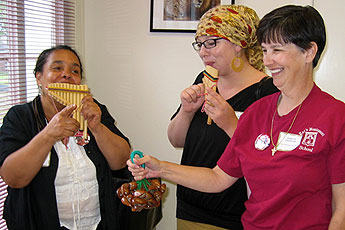
Trainer Olayeela Daste, far left, demonstrates some musical instruments that caregivers can use to promote healing in children.
Mercy Corps Hurricane Katrina Stories; submitted by Tanya Zumach, Senior Web Marketing Manager
Using funds donated by thousands of supporters, Mercy Corps is helping restore a collapsed system of crucial support services for youth in the Gulf Coast. One element of the initiative, Comfort for Kids, reaches out to educators, social workers, and health professionals, giving them the tools they need to minister to traumatized youngsters.
Trainer Olayeela Daste asks the participants in one session to think about how to re-create for children the "pillars of security" - people, routine, ritual, and place. For example, establishing a predictable routine of story times and other activities goes a long way toward restoring a sense of order. For younger children, playing with construction toys can provide a sense of rebuilding their environment.
For children of all ages, workbooks provide a powerful tool for processing traumatic experiences and moving on. Mercy Corps is providing thousands of copies of two publications, My Hurricane Story and My Katrina and Rita Workbook, to schools and health care workers in Louisiana and Mississippi. Together with a curriculum, "What Happened to My World," the resources guide children and adults in the healing process.
Rebuilding the ravaged Gulf Coast isn't simply a matter of bricks and mortar, plywood and stucco. Like the splintered houses and barren landscape, the emotional well-being of the area's residents - especially the children - must also be carefully repaired.
My Hurricane Story
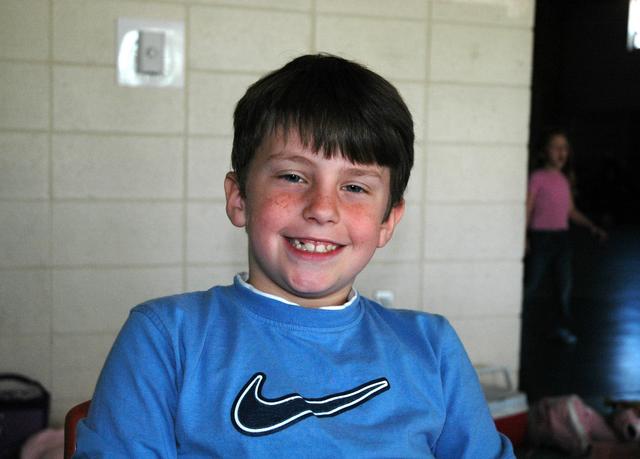
8-year-old Nicholas lost his house, his pet turtle and his friends during Hurricane Katrina and its aftermath. Writing about it helped, he says.
Photo: Dan Sadowsky/Mercy Corps
Here at D'Iberville Elementary School, a few miles from where the Gulf of Mexico laps the sands in front of Biloxi's casinos, nearly every kid has a hurricane story. And the prevailing theme is loss.
Eight-year-old Nicholas lost his house, two sets of friends, his pet turtle and the company of both parents, who separated in the aftermath of the storm.
Nicholas and his classmates at the local Boys & Girls Club were encouraged, through Mercy Corps' Comfort for Kids program, to write essays about how the hurricane affected them.
"I wrote about my pets, my friends, how I had to move back and forth," says Nicholas, a puckish, freckle-faced blonde who broke away from a frenzied game of duck-duck-goose to talk about the experience.
Tara Haney, the D'Iberville site director, says about half the kids lost everything in Hurricane Katrina, which leveled trees and houses and piled up billions worth of damage across coastal Mississippi. Most of the youngsters at D'Iberville are coping better than one might expect, Haney says, but the essays did raise red flags for a few of the kids. The stories were "heartbreaking" to read, she says, but a healthy release for the kids to write. "They were able to get it all out," says Haney.
Nicholas, who is in second grade, had a lot to say. "The hurricane made me move to North Carolina, away from my friends," he says, recounting what he wrote. "And then my new friends in North Carolina, after the hurricane was gone I had to leave them, too."
What's more, the storm coincided with his parents' divorce. Since returning to the Gulf Coast, he's lived with his mom and siblings in a FEMA trailer on the property of a family friend in the town of Gautier, Mississippi, about 15 miles east of D'Iberville. His dad remains in North Carolina.
Writing about his ordeal helped work out some of his feelings, Nicholas says. "At first it was depressing and sad. But if you don't let out your emotions, you're going to explode. So it helped."
Excerpts from essays written by Boys and Girls Club participants through the Comfort for Kids program:
Girl – Age 8
For Katrina I was at my house. Hurricane Katrina hurt our house. It was flat like a pancake really, but I wish I did not stay. I feel really bad about it. It is hard for me. I don’t feel good right now. I wish the hurricane has not come here.
Girl – Age 12
Hurricane Katrina affected us and our Boys & Girls Club. My house and my Boys & Girls Club are gone. My school is a bunch of trailers by the school. The Boys & Girls Club is in the cafeteria. I am living in a trailer as big as a room. Every day we have to use Porti-Pottys. I was very sad because I lost my cats. There is like not one house that is in my neighborhood that is livable.
Boy – Age 13
Hurricane Katrina has affected my life and the Boys & Girls Club Pass Christian Unit in a whole lot of ways. It has affected my life by taking my house and I don’t have anything I used to have such as my old clothes and my scrapbooks. I also lost a lot of pictures of my friends who are no longer here.
Girl - Age 11
My neighborhood was destroyed. It left so many people without family, and houses, and jobs. Then to make it worse, we had to live without TV and water. It made me realize that what I have today could be gone tomorrow. I am thankful that I did not lose my family or friends. Without my family I couldn’t have gotten through the storm. They calmed me down when I got upset.
Boy – Age 11
Katrina affected my life because I had to move. I did not like most of the changes. A lot of things happened to me. My school changed, my house changed, my friends changed and also my family.
Girl – Age 10
When I was hit by the hurricane many things happened, and many things changed. Many of my family died. All of my friends were gone. People say that if you believed in luck your house would still be there, but they were wrong. My house and everything in it was gone. So now we live in a FEMA trailer and we are lucky we are one of those that don’t have to live on the street.
How YOU can raise money and volunteer for the Gulf Coast
Guest blogger Corinne Berkseth and members of her church, Good Shepherd Lutheran in Alexandria, Virginia, raised over $33,000 between December 2005 and April 2006 to rebuild a home destroyed by Hurricane Katrina. With four other Good Shepherd “rebuilders,” Corinne recently joined volunteers rebuilding homes in the low-income area of East Biloxi, Mississippi and hopes their story will inspire others to help. Here are their tips for getting started with raising money or giving time.
When my church, Good Shepherd Lutheran, decided to raise the $25,000 needed to rebuild a home in East Biloxi, we did it to help one, specific family. But in the process, we became part of a broader effort to rebuild the community of East Biloxi. It has been, and continues to be, an amazing experience. Sound like something you or your organization would like to be a part of? If so, consider traveling to Biloxi to provide hands-on construction help, making an individual donation, or organizing an effort to raise $25,000 and sponsor the rebuilding of a home. You will rebuild much more than you can imagine. You will bless a family, a community and yourselves even more!
How to Raise Funds
Think raising $25,000 sounds like a daunting task? We did it, and YOU can, too! Maybe these ideas will kick off your own campaign.
• At Good Shepherd, we formed a committee of about 10 people and coined our house sponsorship effort Rebuild, Renew, Rejoice! We developed a logo and used it with the theme consistently to brand the effort.
• We kicked off our outreach in mid-December with a letter to congregation members and kept them abreast of progress (including heartfelt thank yous!) with announcements in the church bulletin and at services and through a follow-up letter. Individual member donations were a BIG part of our success.
• We encouraged people to be creative in supporting the effort—one member raised $525 (and a $500 company match) through a “pay to wear jeans to work” day at her office. Another asked for donations to Rebuild, Renew, Rejoice! in lieu of birthday gifts.
• The free will offering at a popular church event benefited Rebuild, Renew, Rejoice! and kids in a member’s neighborhood raised $130 by holding a car wash.
• We partnered with Crusader Lutheran in Rockville, Maryland, where we presented the effort during a Lenten dinner program. They collected donations over a couple of weeks and added nearly $500.
• We applied for matching funding through Thrivent Financial for Lutherans.
• Our Sunday School leaders got the children involved and helped them learn about the rebuilding efforts by “building” banks. Their bank collections were then contributed to Rebuild, Renew, Rejoice!
• We held a very successful community silent auction in Old Town on April 1. It was a big effort, but well worth it!
• Although we did not know whose home we would rebuild until the very end of our campaign, we kept the focus on providing concrete help to one specific family. We also contrasted the time that had passed with the need that is still so great on the Gulf Coast and in New Orleans.
The response and generosity of our congregation and our community was more than we could have imagined. We surpassed our goal, raising over $33,000 by our target date of Easter Sunday. These activities worked for us but are just the beginning.
What will you do?
When my church, Good Shepherd Lutheran, decided to raise the $25,000 needed to rebuild a home in East Biloxi, we did it to help one, specific family. But in the process, we became part of a broader effort to rebuild the community of East Biloxi. It has been, and continues to be, an amazing experience. Sound like something you or your organization would like to be a part of? If so, consider traveling to Biloxi to provide hands-on construction help, making an individual donation, or organizing an effort to raise $25,000 and sponsor the rebuilding of a home. You will rebuild much more than you can imagine. You will bless a family, a community and yourselves even more!
How to Raise Funds
Think raising $25,000 sounds like a daunting task? We did it, and YOU can, too! Maybe these ideas will kick off your own campaign.
• At Good Shepherd, we formed a committee of about 10 people and coined our house sponsorship effort Rebuild, Renew, Rejoice! We developed a logo and used it with the theme consistently to brand the effort.
• We kicked off our outreach in mid-December with a letter to congregation members and kept them abreast of progress (including heartfelt thank yous!) with announcements in the church bulletin and at services and through a follow-up letter. Individual member donations were a BIG part of our success.
• We encouraged people to be creative in supporting the effort—one member raised $525 (and a $500 company match) through a “pay to wear jeans to work” day at her office. Another asked for donations to Rebuild, Renew, Rejoice! in lieu of birthday gifts.
• The free will offering at a popular church event benefited Rebuild, Renew, Rejoice! and kids in a member’s neighborhood raised $130 by holding a car wash.
• We partnered with Crusader Lutheran in Rockville, Maryland, where we presented the effort during a Lenten dinner program. They collected donations over a couple of weeks and added nearly $500.
• We applied for matching funding through Thrivent Financial for Lutherans.
• Our Sunday School leaders got the children involved and helped them learn about the rebuilding efforts by “building” banks. Their bank collections were then contributed to Rebuild, Renew, Rejoice!
• We held a very successful community silent auction in Old Town on April 1. It was a big effort, but well worth it!
• Although we did not know whose home we would rebuild until the very end of our campaign, we kept the focus on providing concrete help to one specific family. We also contrasted the time that had passed with the need that is still so great on the Gulf Coast and in New Orleans.
The response and generosity of our congregation and our community was more than we could have imagined. We surpassed our goal, raising over $33,000 by our target date of Easter Sunday. These activities worked for us but are just the beginning.
What will you do?
A Katrina Volunteer's Story

Guest blogger Corinne Berkseth recently joined volunteers rebuilding homes decimated by Hurricane Katrina in Biloxi, Mississippi. Her team, which was organized by Habitat for Humanity of Northern Virginia, rebuilt the home of “Ms. Helen.” Corinne calls the experience the “most incredible and rewarding experience I’ve ever had.”
"Never doubt that a small group of thoughtful, committed citizens can
change the world. Indeed, it is the only thing that ever has."- Margaret Mead, Anthropologist/Scientist (1901- 1978)
Day 1: Arrival—Beach Boulevard
The people of Mississippi are so gracious and so grateful for the help of strangers. We were still at the airport when we were first thanked for coming and helping. I’ve never heard the simple words “thank you” sound as sincere and heartfelt. So began the journey Robbie, Sam, Jaime, Blake and I would travel over the next week plus.
En route from the airport to Our Lady of Fatima Catholic Church, whose convent would serve as our Biloxi home, we drove Beach Boulevard/Highway 90. I had volunteered in Biloxi in September 2005 mucking out flood-damaged homes. Though many had told me there was still much work to be done, I was saddened to see how similar the landscape looked eight months later. It’s not that work hadn’t been done--the massive debris piles that were everywhere in September were all but gone. And yet all along the drive were twisted metal remnants of restaurant signs, bare concrete foundations, apartments, hotels, homes with gaping holes and huge trees pulled out by their root balls. Many months after the storm, the enormity of the Katrina disaster was, and still is, overwhelming. I shared my thoughts with my traveling companions and then tucked them away, not knowing what to do with them,
Day 2: First Day of Construction
Robbie, Jaime, Sam, Blake and I were working on Ms. Helen’s home because our church, Good Shepherd Lutheran in Alexandria, Virginia, had raised money to sponsor the rebuilding of a specific house in Biloxi, through Habitat for Humanity of Northern Virginia (HFHNV). HFHNV estimates the cost of rebuilding a home like Ms. Helen’s—severely damaged by Hurricane Katrina and stripped to the studs and foundation—at $25,000. As we traveled through East Biloxi that next morning, heading to Ms. Helen’s home, I had much the same reaction as I’d had on Beach Boulevard yesterday. By the looks of the neighborhood, there are many other homes in need of sponsorship. But, these thoughts were quickly buried in the activity of stepping into the gutted house, meeting Ms. Helen, and commencing rebuilding construction.
Our house (construction) leader, Hap, a seasoned volunteer from Habitat for Humanity of Northern Virginia, gave us an overview and safety demonstration on all the power tools. Then, he divided us into small groups and distributed construction tasks. Robbie and I were teamed with Donna, another dedicated HFHNV volunteer, who taught us how to frame our first wall (albeit a small one) before lunchtime—wow!
Days 3-33: Construction
Volunteers came and went during a five-week period. Over the next six to 30 days, with a variety of Northern Virginians and Air Force volunteers from nearby Keesler Air Force Base, we framed more walls, sealed gaps between the walls and floors to inhibit the spread of fire (should one ever happen), reinforced floor supports, helped redo pipes and plumbing, patched holes, replaced all the windows, hung insulation and drywall, and much more. From our starts as construction novices, we learned to use a variety of power and other tools, and then were able to actually teach others.
We also got to know our homeowner. Ms. Helen is a widow and a Head Start teacher one year from retirement. She was facing major home repair costs, and soon, a fixed income. The floodwaters reached nearly eight feet high in her home and she lost everything save a few mementos she salvaged from the mud left behind. Since November, she has lived in a FEMA trailer, parked beside her ruined house.
Ms. Helen told us about her feelings of hopelessness as she saw a few houses around her being rebuilt. She raised ten children in this home; it was the only home she’d known for years. Now it was merely a shell and the prospects for rebuilding on her own were grim. But she drew personal strength from prayer and said our efforts were a Godsend. Getting to know her and being able to help in this critical, personal way is the gift we continue to receive.
As a special way of saying thank you, Ms. Helen treated us to home cooked, southern-style lunches on several days—red beans and rice, gumbo, and more—yum! It was a wonderful way of showing her appreciation. Approximately six homes were being worked on during the May construction trip, and other homeowners fed us too.
As the days came and went, we participated in the progress made on rebuilding “our” home, delighting to show Ms. Helen each day what had been accomplished. Many of us were not used to long, hot days (approximately 7:30am-5:00pm, though the time flew by) of manual labor. But it was so satisfying—milestones you could see and photograph and show the homeowner. By the time I returned home, some drywall had been installed on the ceilings and the house was ready for the open-frame and plumbing inspections. The inspections have since passed, drywall has been hung, and the paint Ms. Helen chose is going on the walls. Her home will be completed soon—I couldn’t be more excited for her or to have been a small part of the effort.
Day 5: BBQ at Jerry and Glenda’s
I’m backing up here to return to my tucked away sadness for the rebuilding progress yet to be made in Biloxi, and especially in East Biloxi. These feelings had been in the back of my mind amidst all the construction activity.
At the end of workday number five, we trekked the short distance to Jerry and Glenda’s for a BBQ. It was for me a reunion of sorts. Jerry and Glenda’s home was one of the houses my group had helped gut in September. One of their only belongings to survive Katrina was their barbeque barrel, and they had barbequed for us then too. Our small group had gathered with them on the front porch of their unlivable home where we enjoyed Jerry’s fabulous BBQ and the fellowship of shared work amidst the seemingly hopeless situation they faced back in September.
This night, on day five, was a festival. Loads of their friends and family gathered in the yard, there was a tented roof over a banquet table of food crowned with Jerry’s famous BBQ, a DJ spun music, and a celebration was brewing. Jerry and Glenda were in the process of moving back into their home, and I saw in that gathering the progress that was happening in East Biloxi.
And the progress was springing up around East Biloxi. During the BBQ, I visited with Mr. Price and could see his home across the street—renewed and neat, with a welcoming wreath hanging on the front door. His was the first home I had worked on in September—I had helped to power wash mold out of the gutted interior. It had been the day we had enjoyed BBQ at Jerry and Glenda’s. I was struck by the full circles these two homes, and homeowners, had traveled. And I was encouraged by the progress that was happening, that is happening.
Subscribe to:
Posts (Atom)


